Placing a carbon monoxide detector correctly is your family’s only real defence against a threat you can't see, smell, or taste. Think of it as your silent guardian. An alarm in the right spot is the key to getting an early warning, buying you and your loved ones precious time to get to safety if the unthinkable happens.
Why Correct CO Detector Placement Is a Lifesaver
Before we get into where to put your alarms, it’s vital to understand what we’re up against. Carbon monoxide (CO) gas is produced whenever fuels like gas, oil, coal, and wood don't burn up completely. This means common appliances you use every day—like your boiler, gas fire, cooker, or water heater—can all be potential sources of a CO leak.
Without a detector, the gas can silently build up to deadly levels. What’s truly frightening is that the first signs of CO poisoning mimic the flu: headaches, dizziness, nausea, and confusion. This makes it incredibly easy to dismiss the symptoms until it's far too late.
Carbon Monoxide at a Glance: Key Facts and Dangers
To put the risk into perspective, here’s a quick summary of the key facts about this invisible gas.
| Characteristic | Description | Common Sources in UK Homes |
|---|---|---|
| Appearance | Colourless, odourless, and tasteless. It is completely undetectable by human senses. | Faulty boilers, gas fires, wood burners, clogged chimneys, blocked flues, and portable generators used indoors. |
| How It Spreads | It has a similar density to air, so it mixes freely and spreads evenly throughout a room and your home. | Any fuel-burning appliance that is poorly installed, improperly maintained, or not correctly ventilated. |
| Health Impact | Prevents blood from carrying oxygen. Initial symptoms include headaches, nausea, dizziness, and confusion. | Prolonged exposure can lead to loss of consciousness, brain damage, and, ultimately, death. |
| "Silent Killer" | The nickname comes from its stealthy nature, often incapacitating victims in their sleep. | The risk is highest during winter when heating systems are used more frequently and windows remain closed. |
Recognising these characteristics makes it clear why a properly placed detector isn't just a good idea—it's an absolute necessity.
The Unseen Risk in UK Homes
It's shocking how many households are still left exposed. A recent survey found that around 42% of UK homes don't have a carbon monoxide alarm, leaving millions of people vulnerable. This gap in safety contributes to approximately 40 accidental deaths from CO poisoning each year in England and Wales. You can read the full report about these safety statistics to grasp the true scale of the problem.
This guide is here to give you a clear, no-nonsense roadmap to protect your home. We’ll cut through the jargon and turn confusing guidelines into simple, actionable steps for effective carbon monoxide detector placement.
Carbon monoxide is often called the "silent killer," and for good reason. Because you can't see or smell it, a working, correctly placed detector isn't just another gadget—it's an essential lifesaver on duty 24/7.
What You Will Learn
Throughout this guide, we'll walk you through everything you need to know to make informed decisions and keep your home safe. We’ll cover:
- How CO Gas Behaves: Understanding its movement is key to knowing where to place your alarms.
- UK Legal Standards: We’ll break down the rules for both homeowners and landlords.
- Room-by-Room Placement: Practical, step-by-step instructions for every important area in your house.
- Common Installation Mistakes: Sometimes, knowing what not to do is just as critical.
By the end, you'll feel confident about installing and maintaining your detectors. And for total peace of mind, remember that professional fire safety services can offer expert help with your gas appliances. First, let's start with the science of how this invisible gas actually moves through your home.
Understanding How Carbon Monoxide Moves in Your Home
To get carbon monoxide detector placement right, we first need to get a feel for how the gas itself behaves. It’s not complex, but knowing the basics helps make sense of the official guidance and turns a simple installation into a genuinely life-saving one.
Imagine carbon monoxide as a silent, invisible mist. It doesn't rush into a room; it slowly seeps in, mixing with the air you're breathing. This is precisely why it's so dangerous—the build-up is gradual and goes completely unnoticed until it's often too late.
There’s a common myth that because CO is slightly lighter than air, it shoots straight up to the ceiling. In reality, the difference in density is so negligible that it has almost no effect. CO mixes quite freely and evenly with the air, meaning it can be found at any height in a room.
The Role of Air Currents
The real key to understanding how CO spreads is air movement. Your home isn't a sealed box; it’s a living space with constant air currents that will carry the gas around. These currents can either help your detector do its job or prevent it from sensing danger.
Think about the everyday things that stir up the air in your house:
- Central Heating & Air Conditioning: When your heating comes on, it creates convection currents. Warm air rises, cool air sinks, and this constant circulation pushes air—and any CO mixed with it—all around the room and often into other parts of the house.
- Draughts: Even a small draught from a window or door can push CO away from a detector, delaying the alarm. This is a big reason why you’re told to install alarms away from windows.
- Appliances & People: The hum of a fridge, the fan in an oven, or even just someone walking through a room creates subtle air movements that help disperse gases.
When you think about these forces, the specific rules for carbon monoxide detector placement start to make perfect sense. You're trying to put the alarm in a spot where it can sample the room's typical air, far from anything that might skew its reading or mask a real threat. For a more technical look at home ventilation, the Health and Safety Executive provides some excellent guidance.
Carbon monoxide doesn’t follow simple rules like "always rise" or "always fall." It behaves more like a passenger, carried along by the natural air currents that flow through your home every day.
Why Your Home’s Layout Matters
The unique floor plan of your home is another huge factor. In a modern, open-plan space, CO can spread out far and wide. But in a home with lots of smaller, separate rooms, the gas can become concentrated in one area much more quickly.
Here are a few layout features to consider:
- Stairwells and Hallways: These act like chimneys, funnelling air and any gases between the floors of your home.
- Room Size: If you have a long, rectangular room, CO from a faulty boiler at one end could take a surprisingly long time to reach a detector at the other.
- Doors: A closed door can trap carbon monoxide, allowing it to build up to deadly levels in one room. This is a massive risk, especially for bedrooms.
Once you grasp these simple principles, you realise that detector placement isn't just about ticking a box. It's a strategic decision. You're anticipating how an invisible threat would move through your home and placing your alarms in the best possible position to catch it early.
Decoding UK Legal Requirements for CO Alarms
Getting to grips with legal regulations can feel like a chore, but when it comes to keeping a property safe, it’s a responsibility you can't afford to ignore. The laws around carbon monoxide detector placement in the UK are there for one simple reason: to save lives. They place clear duties on landlords in both private and social housing.
At its core, the legislation is about protecting tenants from the very real dangers of faulty fuel-burning appliances. For landlords, understanding the rules means staying compliant and avoiding hefty fines. For tenants, it means knowing you have a right to a safe home. It’s all about prevention.
The main piece of legislation to know is The Smoke and Carbon Monoxide Alarm (England) Regulations. Since October 2022, the rules have become even stricter. Landlords must now fit at least one working CO alarm in any room used as living accommodation that contains a "fixed fuel-burning appliance." One notable exception here is gas cookers.
Fail to comply, and the consequences can be serious. Local authorities have the power to issue fines of up to £5,000, so this isn't something to take lightly. If you want to dive deeper into the specifics, you can discover more insights about CO in the home.
What Is a Fixed Combustion Appliance?
The legislation really hinges on this specific term: "fixed combustion appliance." Knowing what falls into this category is essential for getting your carbon monoxide detector placement right. In plain English, it’s any permanent, non-portable piece of equipment that burns fuel to create heat.
Think of the most common sources of CO in a typical UK home. The law covers:
- Gas Boilers: All types, including combi, system, and conventional models.
- Gas Fires: Such as those installed in a living room fireplace.
- Log Burners and Wood Stoves: Solid fuel appliances are a major source of risk.
- Oil and Coal-Fired Systems: While less common these days, they are absolutely included.
The law is very specific about what’s not included: gas cookers, hobs, and ovens. While a faulty cooker can certainly produce carbon monoxide, there's no legal requirement to place an alarm in the kitchen just for this reason. That said, nearly all fire services and safety experts strongly recommend fitting one anyway as a best-practice measure.
Landlord and Tenant Responsibilities
The law doesn’t just put all the pressure on landlords. It creates a partnership, with clear responsibilities for both landlords and tenants to keep alarms in working order throughout a tenancy.
"The regulations are not just about initial installation; they create an ongoing duty of care. A landlord's responsibility at the start of a tenancy and a tenant's duty to test regularly work together to ensure the alarm is always ready to respond."
Here’s a straightforward breakdown of who does what:
| Responsibility | Who Is Accountable? | Key Actions Required |
|---|---|---|
| Initial Installation | Landlord | Must ensure a compliant CO alarm is fitted in every required room before a new tenancy starts. |
| Ensuring it Works | Landlord | Must personally check that every alarm is working on the very first day of the tenancy. |
| Regular Testing | Tenant | Responsible for testing alarms often (weekly is ideal) and reporting any problems straight away. |
| Battery Replacement | Tenant | If the alarm is battery-powered, it's the tenant's job to replace them when they run low. |
| Repair or Replacement | Landlord | Once a fault is reported, the landlord must step in to repair or replace the unit as soon as possible. |
This two-way system is designed to provide a constant safety net. The landlord provides the equipment, and the tenant helps maintain it. For the definitive word on your obligations, always check the UK government's official guidance. This teamwork is fundamental to preventing CO poisoning in rental properties.
Ideal Detector Placement Room by Room
Knowing the theory is one thing, but putting it into practice is what actually keeps your family safe. Figuring out the right carbon monoxide detector placement isn't a guessing game; it’s a logical, room-by-room process that ensures you’ve covered all the critical areas.
Let's walk through the most important parts of your home—bedrooms, living areas, kitchens, and hallways—and pinpoint exactly where your detectors should go. Follow these straightforward guidelines, and you’ll create a safety net you can rely on.
Where to Place Alarms Near Bedrooms and Sleeping Areas
Bedrooms are, without a doubt, the most important place to protect. When you’re awake, you might notice the early signs of CO poisoning, but when you’re asleep, you’re completely vulnerable. A piercing alarm is the only thing that can wake you in time.
For this reason, you should have a detector on every level of your home, placed in the hallway outside the main sleeping areas. If your bedrooms are in different wings of the house, each sleeping "zone" needs its own alarm. For an extra layer of protection—especially for children or the elderly—placing another alarm inside the bedroom itself is a very smart move.
The goal is simple: make sure the alarm is loud enough to wake even the soundest sleeper.
Living Rooms with Fireplaces or Log Burners
Any living room with a fuel-burning appliance, like a gas fire or a wood-burning stove, is a high-risk area. These are prime sources for potential CO leaks, making correct carbon monoxide detector placement absolutely essential here.
When fitting an alarm in these spaces, keep these points in mind:
- Get the Distance Right: Position the detector between 1 and 3 metres horizontally from the appliance. This is the sweet spot—close enough to catch a leak quickly but far enough to prevent false alarms from the harmless puff of fumes you get when lighting a fire.
- Think About Height: On a wall, mount the alarm at least 15 cm (6 inches) down from the ceiling, but make sure it’s higher than the top of any door or window. If you’re mounting it on the ceiling, it needs to be at least 30 cm (1 foot) away from any wall. This keeps it out of "dead air" spaces where gases can get trapped and go undetected.
- Ensure a Clear Path: Never let furniture, curtains, or other objects block the detector. It needs an unobstructed flow of air to do its job.
This image gives a great visual breakdown of the rules for walls versus ceilings.
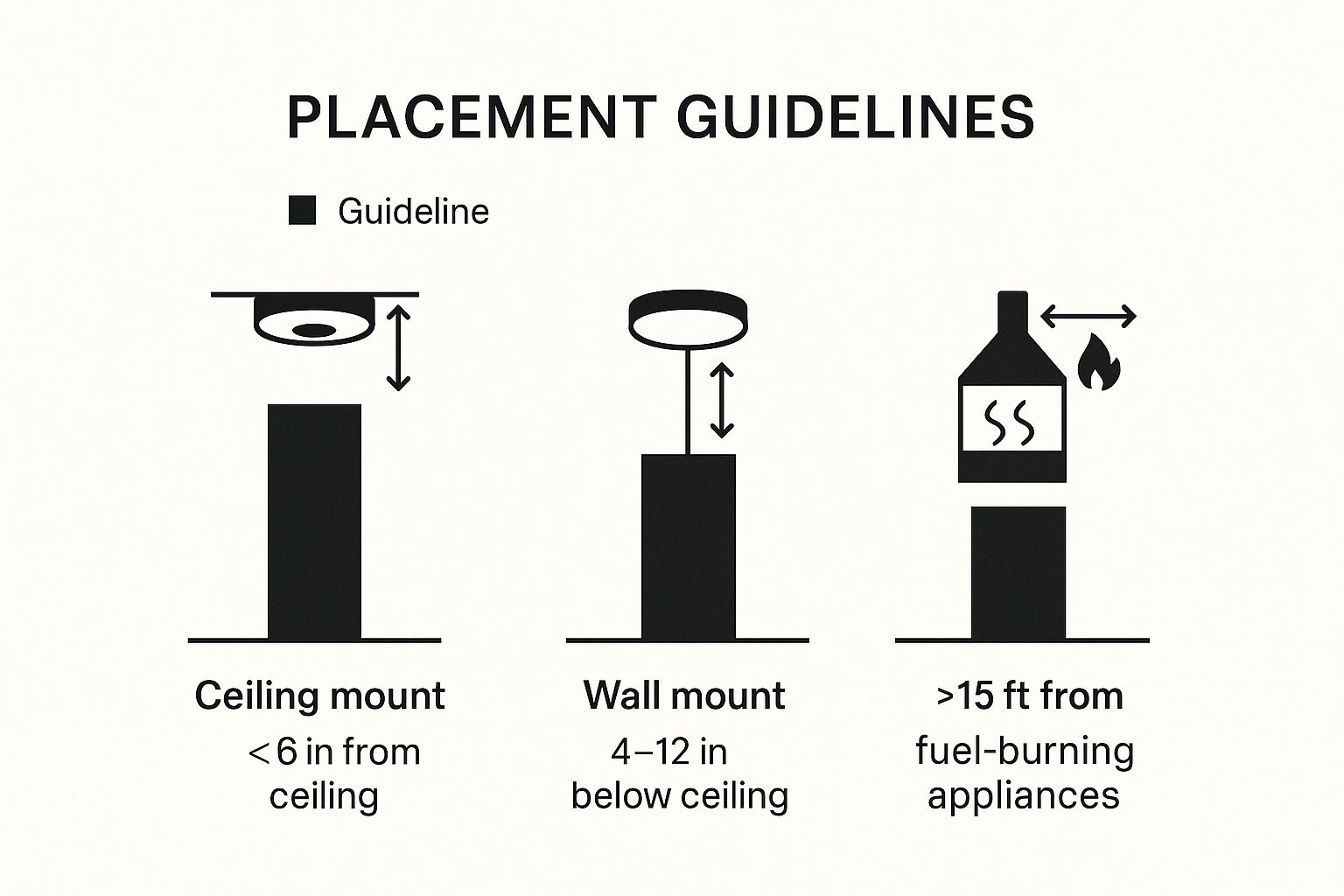
The main takeaway here is that whether you choose the wall or the ceiling, avoiding corners and keeping a safe distance from the appliance are the two most critical factors.
Kitchens and Utility Rooms with Boilers
While there's no specific legal requirement in the UK for a CO alarm for a gas cooker, it is mandatory if a room contains any solid fuel-burning appliance, like a boiler. Since many modern homes have their boiler in the kitchen or a utility room, these areas are crucial.
The placement rules are very similar to those for a living room with a fire. You need to maintain that safe distance from both the boiler and the cooker to avoid nuisance alarms during normal use, while still being near enough to catch a genuine leak. For a deeper dive into this, our guide on home appliance safety has some excellent tips.
Think of your detector's placement like a strategic listening post. It needs to be close enough to hear the first whispers of danger (a CO leak) but not so close that it gets distracted by the normal background noise of your appliances firing up.
Hallways and Connecting Spaces
Hallways are the arteries of your home. They connect rooms and floors, making them the natural route for carbon monoxide to travel from its source to other areas—especially the bedrooms. Placing a detector in a central hallway on each level of your home is a cornerstone of any good safety plan.
When you’re deciding on carbon monoxide detector placement in these spaces, make sure the alarm is centrally located and can be easily heard from all the surrounding rooms. This effectively turns your hallways into an early-warning corridor, protecting the path between a potential leak and your family while they sleep.
CO Detector Placement Do's and Don'ts
To make things even clearer, here’s a quick-reference table that summarises the key placement rules. It’s an easy way to double-check that you’re getting it right.
| Placement Guideline | Do This (Correct Placement) | Don't Do This (Incorrect Placement) |
|---|---|---|
| Distance from Appliance | Place 1-3 metres away from any fuel-burning appliance. | Place it directly above or next to the appliance. |
| Wall Placement | Mount at head height, at least 15 cm below the ceiling. | Install it near the floor or right in a corner. |
| Ceiling Placement | Position at least 30 cm away from any wall or light fixture. | Place it in the corner where the wall and ceiling meet. |
| Location Near Vents | Keep it away from draughts from windows, doors, or air vents. | Install it directly in the path of moving air. |
| Humid Areas | Avoid kitchens and bathrooms where steam can cause false alarms. | Place it right next to a cooker, shower, or kettle. |
| Obstructions | Ensure the detector is in the open with no furniture blocking it. | Put it behind curtains, shelves, or large furniture. |
By following these simple do's and avoiding the common don'ts, you can be confident that your detectors are positioned for maximum effectiveness, ready to alert you when it matters most.
Common Placement Mistakes That Put You at Risk
Even with the best of intentions, a simple mistake in carbon monoxide detector placement can make your alarm practically useless. Knowing what not to do is every bit as important as following the right guidelines.
Let’s walk through the most common errors we see homeowners make. These slip-ups can either trigger frustrating false alarms or, far more dangerously, stop the detector from sensing a real CO leak until it’s too late. A quick check of your setup against this list could make all the difference.
Too Close to Fuel-Burning Appliances
One of the most frequent mistakes is putting a detector right next to a boiler, gas fire, or cooker. It seems logical—place it near the source, right? The problem is that these appliances often release a tiny, harmless puff of CO when they first start up.
This brief emission is enough to trigger a nuisance alarm, making you think the unit is faulty when it’s not. To avoid this, always keep a safe distance: between one and three metres (about 3 to 10 feet) away from any fuel-burning appliance. This gives the detector a clear read of the room's air without being fooled by normal operation.
Placing a CO detector is a balancing act. It needs to be close enough to the potential source to detect a leak quickly, yet far enough away to avoid the false alarms that lead people to ignore or even unplug them.
In Humid or Damp Environments
Another spot to avoid is a bathroom or a very damp utility room. High humidity and steam are the enemies of CO sensors. The moisture in the air can mess with the internal electronics, leading to dodgy readings or even damaging the unit over time.
This not only causes false alarms but can also shorten your detector’s lifespan. Stick to dry areas where the air quality is typical of your main living spaces. For more on creating a safe home, the National Fire Protection Association offers excellent resources covering a wide range of safety topics.
In the Path of Draughts or Vents
Airflow is a huge factor. Placing a detector next to a window, an exterior door, or directly in front of a heating or air conditioning vent is a classic blunder. A strong draught can simply blow the invisible CO gas away from the sensor, meaning it never gets a chance to trigger the alarm.
Just as bad are "dead air" spaces. Think of the corners where walls meet the ceiling, or inside a stuffy cupboard. Air doesn't circulate well here, so CO could be building up in the middle of the room while the detector in the corner remains completely oblivious. Always position your alarm where it can sample the room’s freely circulating air.
Obstructed and Hidden Locations
Finally, a detector can’t protect you if its sensors are blocked. It’s a common oversight to let furniture, bookshelves, or even heavy curtains get in the way of the unit. Your detector needs a clear, unimpeded flow of air to work properly.
Before you install it, take a look around and make sure the spot will stay clear and visible. Hiding an alarm behind a plant for aesthetic reasons is a dangerous trade-off. It needs to be out in the open, ready to do its job. If you’d like an expert eye on your home's gas systems, our Wigan-based boiler specialists are always here to help.
Testing and Maintaining Your Carbon Monoxide Detectors
Getting your carbon monoxide detector placement right is a massive step towards a safer home, but the job isn’t quite finished. Once that detector is on the wall, it needs a little bit of attention to make sure it can do its job properly.
Think of it like the annual MOT on your car. It’s a quick, simple check to confirm everything is running as it should. After all, a detector with a dead battery or a blocked sensor is no better than having no detector at all. A few minutes of simple maintenance can provide years of peace of mind.
Your Weekly Safety Check
Make it a habit to test your alarms every week. It’s the single best way to know they’re ready to respond in an emergency, and it only takes a few seconds.
Just press and hold the 'test' button on each detector until the alarm screeches to life. This quick action confirms that the power source, the sensor, and all the internal electronics are working together correctly. A good tip is to tie it into another weekly chore, like taking the bins out, so you never forget.
Keeping Your Detectors Clean
Dust, cobwebs, and even airborne grease from cooking can build up on your detectors over time. If the vents get clogged, it can seriously slow down—or even stop—the sensor from picking up on the presence of carbon monoxide.
To keep the sensors clear, a little light cleaning is all that's needed:
- Dust Gently: About once a month, run the soft brush attachment of your vacuum cleaner over the casing and vents.
- Wipe Carefully: For any stubborn grime, a dry or slightly damp cloth will do the trick. Just be sure to avoid harsh chemical cleaners or solvents, as these can permanently damage the sensitive internal components.
Maintaining your CO detector is a partnership. You provide the power and a clean environment; it provides the 24/7 vigilance needed to keep your family safe.
Knowing When to Replace Batteries and Alarms
It’s vital to understand the difference between the sounds your detector makes. A full-blown, continuous alarm is an emergency. But a short, repeating "chirp" every minute or so is usually a low-battery warning. When you hear that chirp, replace the batteries straight away.
Beyond batteries, the entire detector has a limited lifespan. The sensors inside degrade over time, eventually becoming less effective. Most CO detectors last between five and ten years. You’ll find an expiry or "replace by" date printed on the unit itself. Mark that date on your calendar and replace the whole alarm before it’s up. If you need a hand keeping track of your home’s safety tasks, our internal maintenance checklist is a great resource.
Your CO Detector Questions Answered
Even with the basics covered, you probably still have a few nagging questions about carbon monoxide detector placement. Let's tackle some of the most common ones we hear from homeowners, so you can feel completely confident your home is properly protected.
How Many CO Detectors Do I Actually Need?
The right number really depends on the size and layout of your house. At an absolute minimum, you need at least one CO detector on every level, and that includes finished basements and attics.
For the best possible protection, though, you should also have one in the hallway just outside each separate sleeping area. If you live in a larger, more spread-out home, you might need a few more to ensure there are no blind spots.
Is It Okay to Install a Detector in the Garage?
It seems like a good idea, right? After all, car exhaust is a major source of CO. However, placing a detector right inside the garage is a common mistake. The fumes from just starting your car can easily set it off, leading to frequent false alarms.
A much better approach is to put the detector in the room or hallway that connects directly to the garage. That way, it will alert you if CO starts to leak from the garage into your actual living space.
It's easy to assume a smoke alarm will also pick up carbon monoxide, but they won't. They are two completely different devices, built to sense entirely separate dangers. For full protection, you absolutely need both.
What Is the Difference Between a Smoke Alarm and a CO Detector?
This is a critical point to understand. A smoke alarm's job is to detect tiny particles of smoke in the air, warning you of a fire. A carbon monoxide detector, on the other hand, is specifically designed to sense the presence of that one poisonous gas.
A smoke alarm will not detect carbon monoxide, and a CO alarm will not detect smoke. While you can buy combination units that do both, never assume one device does the other’s job unless it’s clearly marked. For a deeper dive into smoke alarms, the National Fire Protection Association provides clear guidance.
What Do I Do if My Alarm Goes Off?
If that alarm starts blaring, you need to move fast. Never, ever write it off as a false alarm.
- Get Out Immediately: Your first and only priority is to get everyone—people and pets—out of the house and into fresh air.
- Call for Help: As soon as you're safely outside, call 999 from your mobile or a neighbour’s phone.
- Stay Out: Do not go back inside for any reason. Wait for the emergency services to arrive and give the all-clear.
At Jjk gas services, we believe that a well-maintained boiler is a safe boiler. If you have any concerns about your gas appliances or need expert installation and repair, ensure your home's safety by visiting us at https://www.jjkgasservices.co.uk.
Article created using Outrank