To find out your home's water pressure, you'll need a simple pressure gauge. Just attach it to an outdoor tap, like your garden hose connection, and you’re ready to go.
Before you start, make sure every other tap and water-using appliance in the house is off. Once everything is shut, turn the garden tap on fully. This will give you a clear, accurate reading in either Bar or PSI, instantly telling you if your pressure is too low, too high, or right where it should be.
Why Your Home's Water Pressure Matters
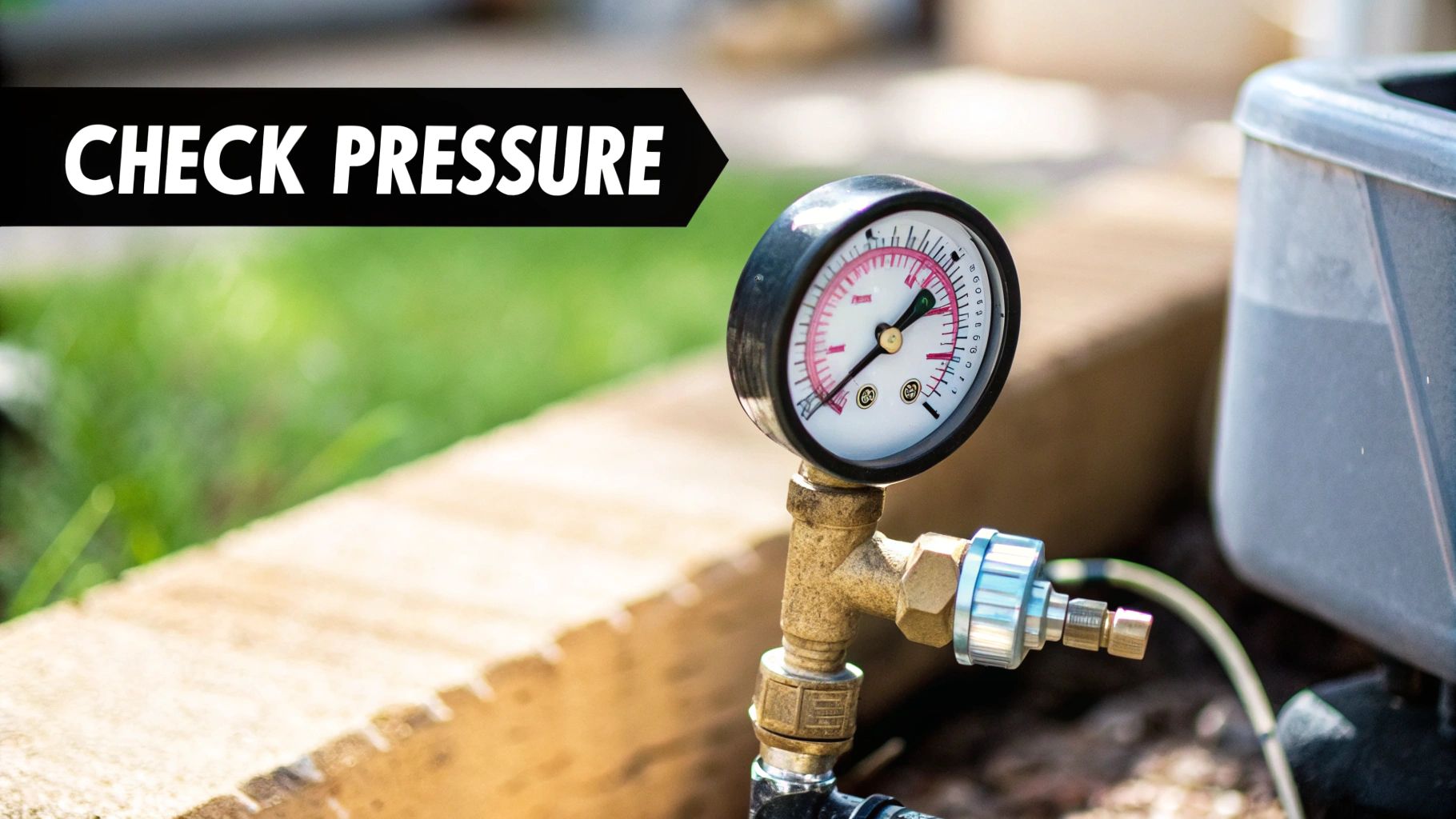
So, what exactly are we measuring? Water pressure is simply the force pushing water through your pipes. Getting this balance right is crucial. It dictates everything from how satisfying your morning shower is to how long your washing machine and boiler will last.
When the pressure is out of whack, the signs are usually obvious. Low pressure results in those frustrating, weak showers and taps that take an age to fill the kettle. On the other hand, high pressure can lead to noisy, banging pipes—a problem plumbers call 'water hammer'. Over time, that constant high pressure puts a huge strain on your entire system, leading to leaky joints and worn-out appliance parts. Learning how to check your water pressure is the first, essential step to catching these problems early.
Understanding Pressure Readings and Ideal Ranges
In the UK, you’ll most often see water pressure measured in bar. Some gauges also use pounds per square inch (PSI), and the conversion is straightforward: 1 bar is roughly 14.5 PSI.
For the average UK home, the sweet spot for water pressure is usually between 1.0 and 1.5 bar.
If your gauge shows anything below 1.0 bar, it's on the low side, which explains why your flow feels a bit feeble. Conversely, if the needle is consistently creeping above 2.0 bar, you could be heading for trouble.
It's worth remembering this isn't just about your house. Water companies are constantly managing pressure across the network to minimise leaks and save water. It's a nationwide effort, and it directly influences what comes out of your taps.
Getting your head around these numbers is key. It turns a simple reading on a gauge into a real insight into the health of your home's plumbing. You’ll know straight away if things are as they should be or if it’s time to take action. If you're ever in doubt, getting a professional opinion from a team like JJK Gas Services can clear things up.
Getting the Right Tools for an Accurate Test
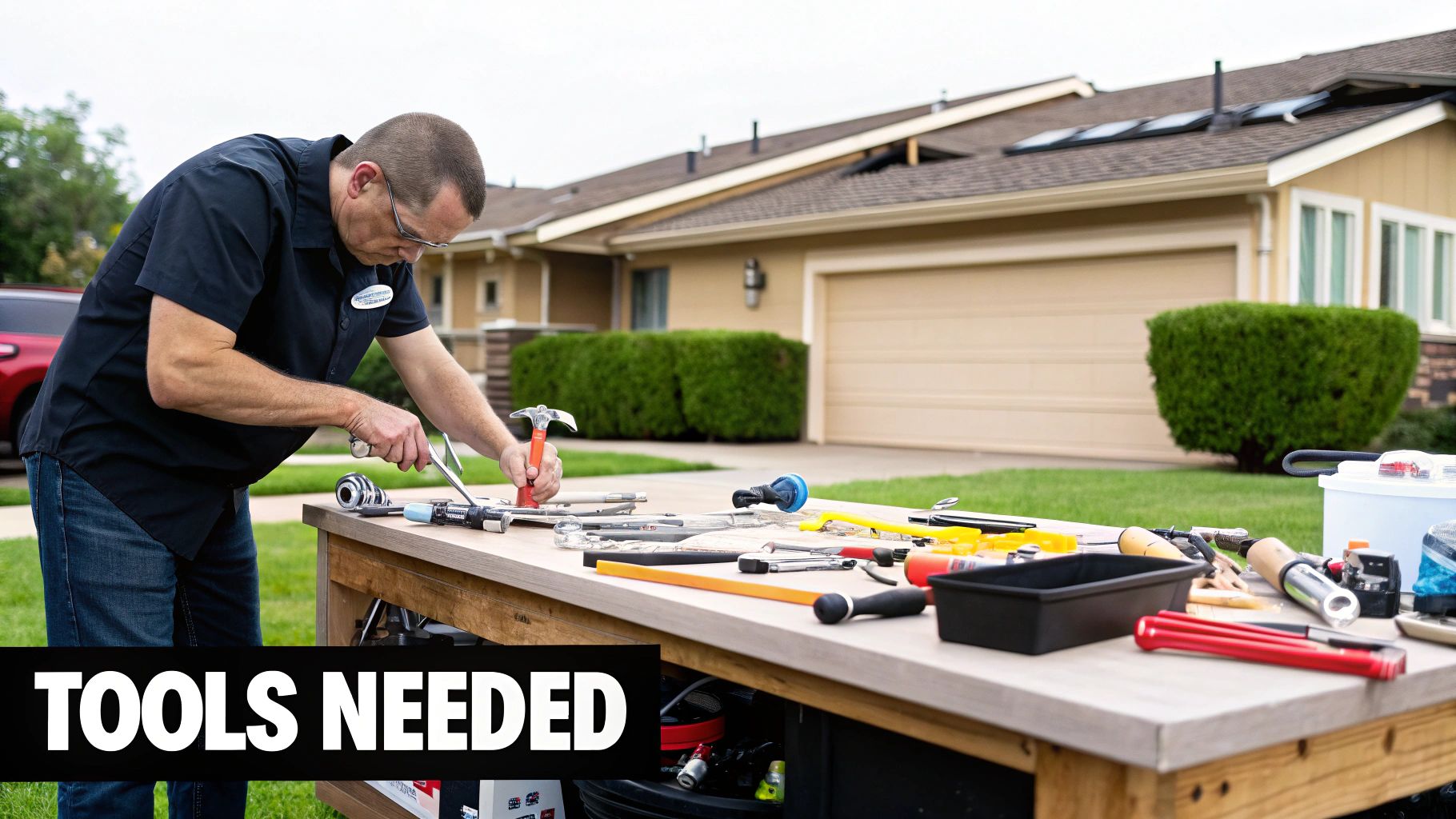
Before you can get a reading on your water pressure, you’ll need one key piece of kit: a water pressure gauge. It’s a simple tool, but picking the right one from the start is the difference between a quick, reliable test and a frustrating afternoon.
You can easily find these gauges at any local DIY shop or online. You’ll see both digital and classic analogue dial models, but honestly, a standard analogue gauge is all you need. They're robust, easy to read, and get the job done perfectly well for household checks.
Selecting the Right Gauge for UK Taps
The most important thing to check is the fitting. To get a snug, leak-free connection on your outdoor tap, you need a gauge with a ¾ inch BSP (British Standard Pipe) thread. This is the standard size for almost all garden taps here in the UK, so getting this right is crucial for an accurate reading.
Water companies generally advise using the correct tools, and for good reason. From experience, typical UK water pressure sits somewhere between 1.0 and 4.0 bar. If your reading dips below 1 bar, you'll definitely notice it in weak showers. Conversely, anything over 5 bar starts to put serious strain on your pipes and appliances. You can find more insights on leakage from Ofwat.
One last tip before you begin: when you unbox your new gauge, just double-check that the needle is sitting perfectly on zero. If it's a bit off, your reading won't be spot on. A quality gauge is a small investment, but it's one that lets you keep a close eye on your home’s plumbing health.
Getting an Accurate Water Pressure Reading
Right, you’ve got the pressure gauge. Now, let’s get a reading you can actually trust. While checking your water pressure is a simple job you can do yourself, getting it right comes down to a few key details. Miss one, and you could end up with a misleading number.
First things first, you need to create what plumbers call a 'closed system'. This just means making sure no water is running anywhere inside or outside your house. That includes shutting off all taps and showers and ensuring appliances like your dishwasher or washing machine aren't in the middle of a cycle. Even a toilet cistern refilling can throw off the measurement, giving you a falsely low reading.
Finding the Right Place to Test
For the most accurate result, your outside garden tap is almost always the best spot. Why? Because it’s usually one of the first take-offs from the mains water supply as it enters your property. Testing here gives you a true picture of the pressure coming into your home before it snakes through metres of internal pipework. Testing at the kitchen sink, for instance, might show a slightly lower pressure simply due to the distance the water has travelled.
Once you’ve picked your tap, screw the pressure gauge onto the threaded spout. You're aiming for a good, watertight seal, so tighten it firmly by hand.
A Quick Tip From The Field: Whatever you do, don't reach for a wrench to tighten the gauge. You'll likely damage the rubber washer inside, which can cause leaks and wreck the gauge. A solid, hand-tight fit is all you need for a perfect seal.
Taking the Measurement and What It Means
With the gauge attached, turn the tap on fully. You’ll see the needle on the dial jump up and then settle. That final position is your home's static water pressure. Jot down the number, noting whether it’s in bar or PSI (pounds per square inch).
This simple process is really all there is to it, as this visual guide shows.
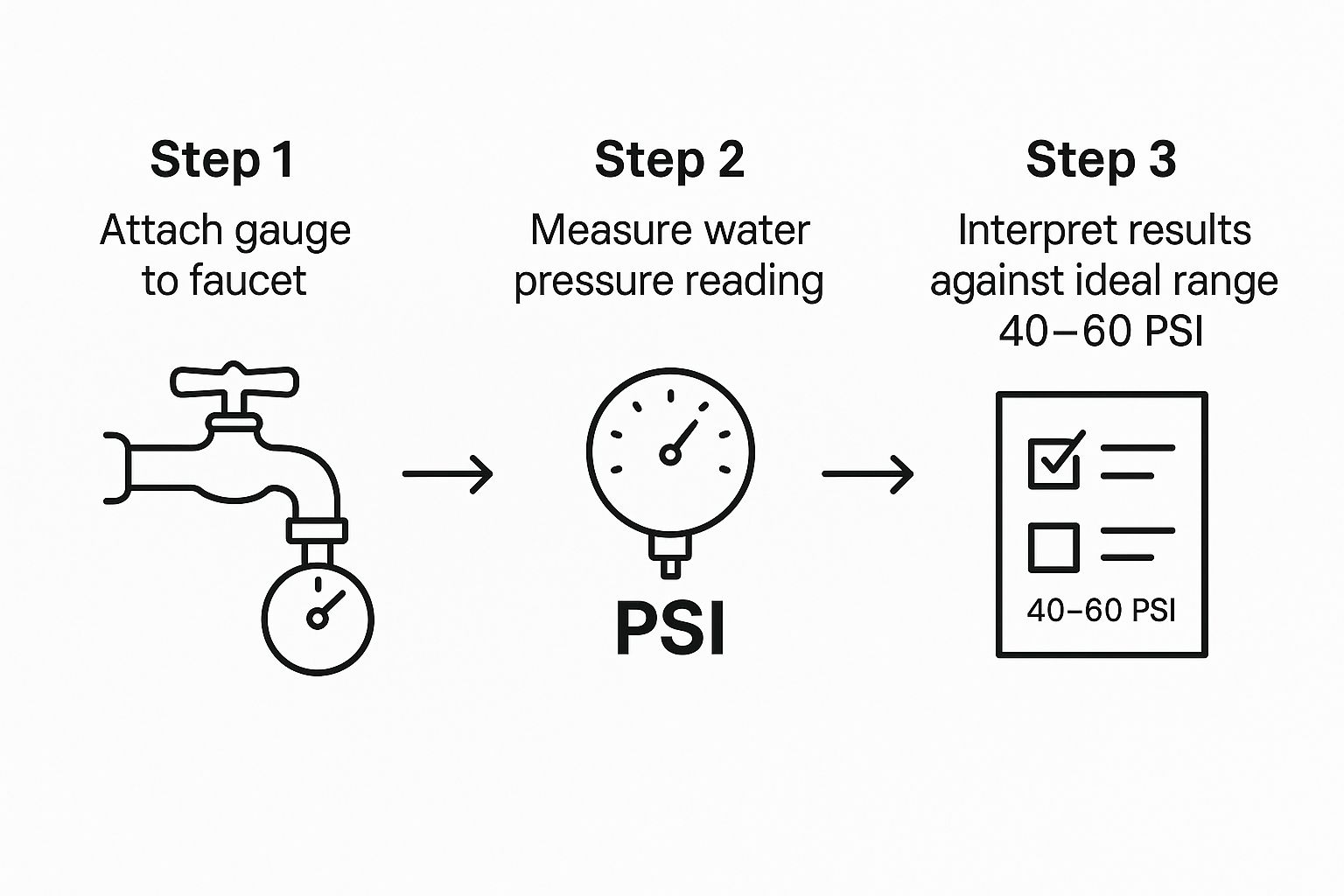
As you can see, it's a straightforward path from connecting the gauge to reading the dial and figuring out if your pressure is in the healthy range.
One final piece of advice – don't just test once. Water pressure can change throughout the day. It's often lower in the morning when everyone in your area is showering and higher in the middle of the day when demand drops. Taking a reading at peak and off-peak times will give you a much better overall picture.
Of course, if the numbers look off or you suspect a deeper issue with your plumbing, it's always best to get a professional opinion. Our team at JJK Gas Services can quickly diagnose and sort out any water pressure problems you might have.
Making Sense of Your Water Pressure Reading
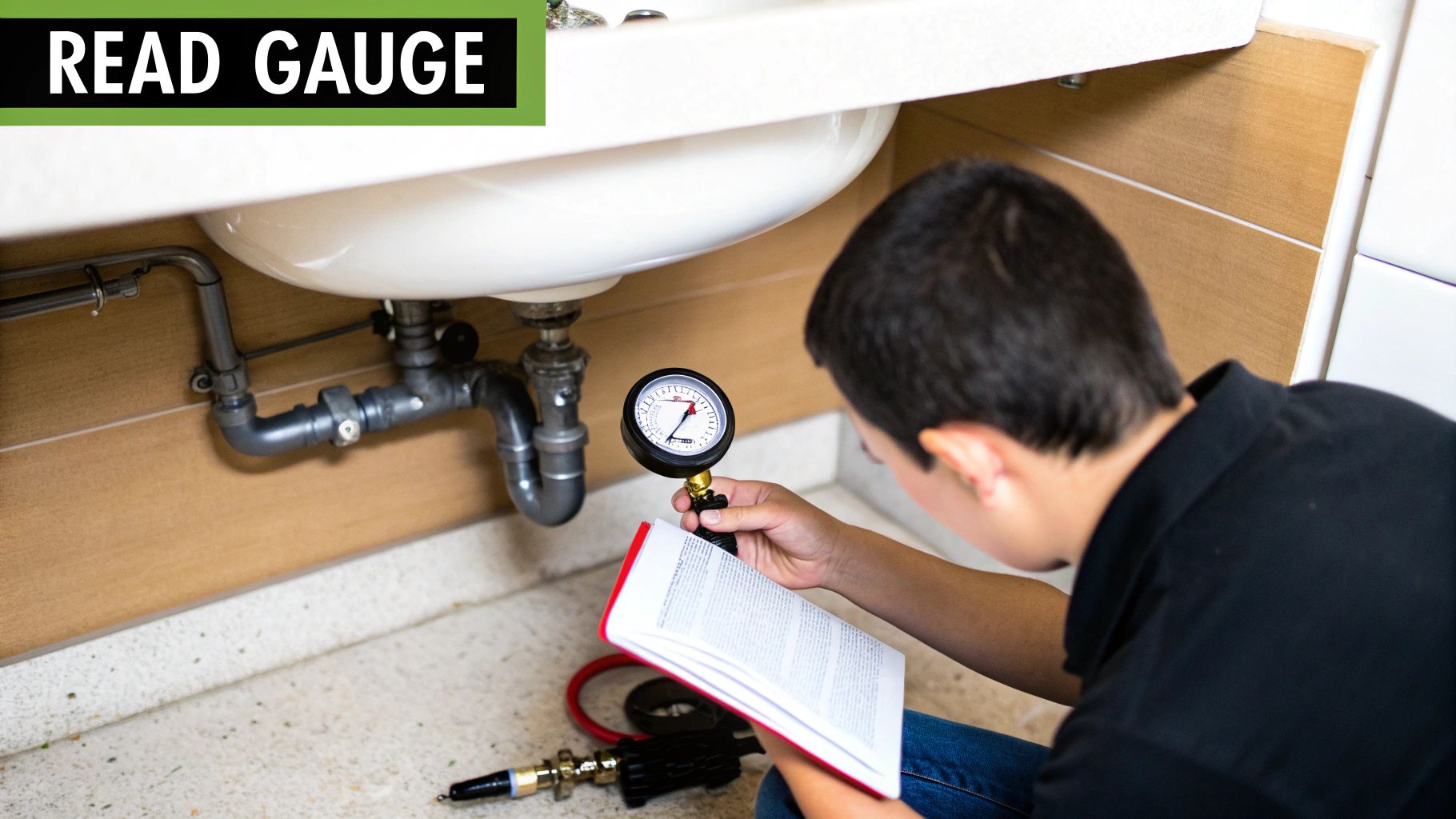
So, you've got a number staring back at you from the gauge. What does it actually mean for your home? This simple measurement is a window into the health of your plumbing system, telling you whether everything is running smoothly or if there's an issue brewing behind the scenes.
Translating that number, whether it's in bar or PSI, is the crucial next step. It allows you to quickly figure out if the water entering your property is too low, too high, or just right for a typical UK household.
What’s a Good Reading to Aim For?
In my experience, the sweet spot for most UK homes is a pressure reading somewhere between 1.0 and 2.0 bar (that's roughly 15-30 PSI).
When your pressure sits in this range, you get that satisfyingly powerful shower, taps fill the kettle without taking an age, and crucial appliances like your boiler and washing machine can do their jobs properly. They’re getting the flow they need without being subjected to damaging strain.
If your gauge shows a number in this ideal zone, you can rest easy knowing your system is likely in good shape. This balanced pressure protects your pipe joints, valves, and appliance seals from premature wear and tear, which can save you a lot of hassle and money down the line.
A consistent reading here is fantastic news. But if your number is sitting outside these boundaries, it's a clear signal to start looking for the cause.
Remember, extremely low or high pressure is more than just a minor inconvenience. It’s often a symptom of a hidden problem. A surprisingly low reading could point to anything from a partially closed stopcock to a hidden leak, while an unusually high one might indicate an issue with the mains supply in your street.
What Your Reading Tells You
To help you get to the bottom of it, let's break down what different readings often mean and what could be causing them.
This quick-reference table is a great starting point for understanding what's going on with your water pressure and identifying potential culprits.
Water Pressure Reading Interpretation and Common Causes
| Pressure Reading (Bar) | Classification | Potential Causes |
|---|---|---|
| Below 1.0 bar | Low Pressure | A partially closed stopcock, clogged pipework or tap aerators, or a hidden water leak. |
| 1.0 – 2.0 bar | Ideal Pressure | Your plumbing system is likely operating correctly within the recommended range. |
| Above 2.5 bar | High Pressure | Could be due to your home's location (e.g., at the bottom of a hill) or an issue with the local mains supply. |
After looking at the table, you should have a much clearer idea of where your system stands. If everything is in the green, great! If not, you know what to investigate next.
It's also worth remembering that getting your pressure right isn't just about your home. On a larger scale, excessive pressure in the mains network is a major contributor to leaks and water wastage. In fact, there are national targets in place to manage consumption, as detailed in these national water usage trends. By fixing pressure issues at home, you’re also doing your bit for conservation.
If you find your pressure is consistently too high or too low and you're not sure why, our team at JJK Gas Services can get to the root of the problem.
What to Do About Low or High Water Pressure
So, you’ve got your reading and it’s not what you hoped for. Don't panic. The good news is that many common water pressure problems have surprisingly simple fixes that you can often handle yourself, saving you the cost of calling in a plumber right away.
Tackling Low Water Pressure
If your pressure is disappointingly low, start with the basics before you assume the worst. The first thing I always check is the main stopcock. This is the valve that controls all the water coming into your home, usually hiding under the kitchen sink or in a utility cupboard.
It's amazing how often these get partially closed after some other work has been done and then forgotten about. Make sure it's turned fully anti-clockwise to ensure it's completely open.
Another common offender, especially if the low pressure is only at one or two taps, is a blocked aerator.
Getting a Better Flow from Your Taps
That little mesh screen on the end of your tap is called an aerator, and it's a magnet for limescale and tiny bits of grit. When it clogs up, it strangles the water flow and can make perfectly good pressure feel frustratingly weak.
Giving it a clean is a quick job that can make a world of difference:
- Gently unscrew the aerator from the tap – you might need a cloth for grip.
- Pop it into a small pot of white vinegar or a descaling solution for an hour or so.
- After its soak, give it a gentle scrub with an old toothbrush to dislodge any stubborn bits.
- Rinse it clean, screw it back on, and you should see a much healthier flow.
Dealing with High Water Pressure
High pressure is a different beast altogether. While low pressure is an annoyance, high pressure can actively damage your plumbing and appliances over time. The key here is usually a device called a Pressure Reducing Valve (PRV).
If your gauge showed a high reading, the first step is to see if you already have a PRV installed. Look for a bell-shaped valve on the pipework, usually not far from your main stopcock. If you have one, it might just need a simple adjustment to bring the pressure back into the safe zone.
Adjusting a PRV isn't too complicated, but you need to do it correctly. There are some fantastic step-by-step guides out there, like the resources provided by Water UK, that can walk you through the process safely.
When You Should Call a Professional Plumber
While it’s tempting to tackle every home repair yourself, there are definitely times when a water pressure problem needs a professional eye. Knowing when to put the tools down and call in a qualified plumber can save you a world of hassle, not to mention a lot of money and potential water damage. A pro can diagnose tricky issues that just aren't obvious to the untrained eye.
Let's say you've gone through all the basic checks for low pressure, but the problem is still there. This is a classic sign you might be dealing with something more sinister, like a hidden leak somewhere in your pipework. Finding and fixing those requires specialist gear and years of experience.
Another common scenario is dealing with a Pressure Reducing Valve (PRV). If you need one installed or an old one replaced, it’s a job that needs to be done right. A badly fitted PRV can cause all sorts of new problems, from loud water hammer to incorrect pressure settings that make your original issue even worse.
When Your Water Supplier Is Responsible
It's also crucial to know where your responsibility ends and the local water supplier's begins. They're in charge of the water network and pressure right up to your property's boundary line, which is usually where you'll find an external stopcock.
A good rule of thumb? If your neighbours are all complaining about the same pressure problems, the issue is almost certainly with the mains supply.
In that situation, your first port of call should be your water company. It’s their job to investigate and fix pressure problems on their side of the network, and a quick phone call could save you from an unnecessary plumber's bill.
Ever since the major droughts back in the 1990s, UK water companies have had strict leakage and pressure targets to meet, so they tend to be pretty responsive. If all your checks point to a wider issue beyond your property, getting in touch with them is the right move. You can find out more about the history of the UK's water resource management and how these strategies were developed over on the CEH.ac.uk website.
Your Water Pressure Questions, Answered
When you start digging into the details of your home's water pressure, it’s natural for a few questions to pop up. Let's tackle some of the most common queries we hear from UK homeowners, giving you the clarity to sort out any issues with confidence.
Can My Water Pressure Fluctuate During the Day?
Yes, it certainly can, and it's a very common occurrence. You'll often notice a slight dip in pressure during peak hours—think early mornings when everyone's getting ready for work and school, or evenings when people are cooking and running dishwashers.
This is simply down to high demand on the local water main. For this reason, it's always a good idea to test your pressure a couple of times throughout the day to find a reliable average.
What's the Difference Between Water Pressure and Water Flow?
This is a brilliant question and a frequent source of confusion. The easiest way to think about it is that pressure is the force pushing the water through your pipes, while flow is the volume of water that actually comes out of the tap.
You could have fantastic pressure, but if you've got a partially blocked pipe or a clogged-up tap aerator, your flow will be frustratingly poor. If you want to dive deeper into this, the Consumer Council for Water has some great resources.
So, What Is a Good Water Pressure Reading in the UK?
For most UK homes, you're looking for a sweet spot between 1.0 and 2.0 bar. This is the ideal range to keep modern combi boilers happy and ensure you get a decent shower. It’s powerful enough for your needs without putting undue stress on your plumbing system.
If your gauge is consistently showing a reading above or below this range, it’s a definite signal that something needs looking into.
Don't forget that both extremely low and surprisingly high pressure can point to problems. Low pressure could be a sign of a hidden leak, while pressure that's too high can wear out your pipes and appliances much faster, sometimes hiking your water bills by as much as 30%.
Can I Fix Water Pressure Problems Myself?
Some issues are perfect for a bit of DIY. Things like cleaning out the small aerator filter on the end of your taps or making sure your main stopcock is fully open are straightforward fixes you can definitely try.
However, for anything more involved—like fitting or adjusting a Pressure Reducing Valve (PRV) or investigating a leak—it’s always best to bring in a qualified professional. It’s just not worth the risk of getting it wrong.
If you’re still wrestling with water pressure headaches or need an expert to check your boiler's performance, the experienced team at JJK Gas Services is ready to help. Get in touch with us for reliable, professional solutions in the Wigan area at https://www.jjkgasservices.co.uk.
Article created using Outrank